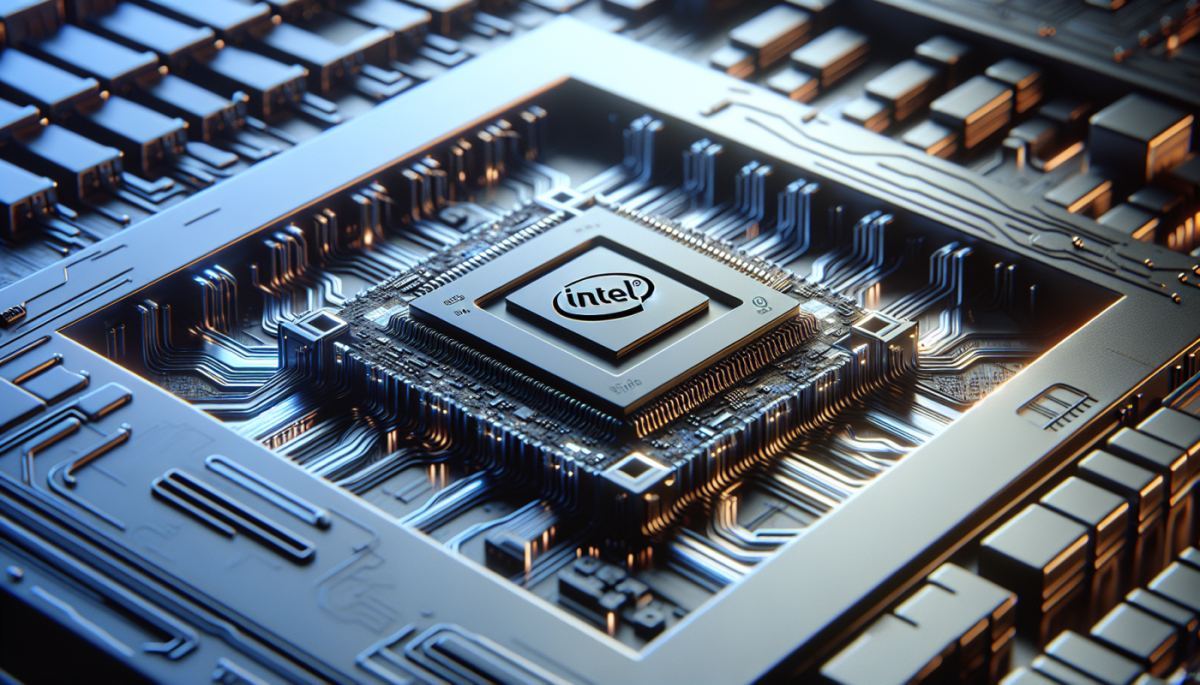
For decades, the fundamental bargain of cloud computing has been an uncomfortable one: to process your data, a server has to see it. Encryption protects information in transit and at rest, but the moment computation begins, the data must be exposed. Fully homomorphic encryption, or FHE, has long promised to break that bargain entirely, allowing servers to crunch numbers on data they can never actually read. The problem has always been speed. Until now, FHE has been so computationally expensive that it remained largely a theoretical curiosity. Intel's new Heracles chip is a direct attempt to change that calculus.
Heracles, built on a 3-nanometer FinFET process and paired with high-bandwidth memory, reportedly accelerates FHE workloads up to 5,000 times faster than Intel's own top-tier server CPUs. That is not an incremental improvement. It is the kind of leap that moves a technology from academic papers into procurement conversations. The chip is purpose-built for the mathematical operations that FHE demands, particularly the enormous polynomial arithmetic and number-theoretic transforms that make encrypted computation so punishing for general-purpose hardware. Standard CPUs and GPUs were never designed with these operations in mind, which is precisely why FHE has languished despite its theoretical elegance.
Intel is not alone in this pursuit. A cluster of startups has been quietly building FHE accelerators for several years, betting that the demand for privacy-preserving computation would eventually outpace the tolerance for its costs. Companies working in sensitive verticals, including healthcare, finance, and defense contracting, have strong regulatory and competitive incentives to process data without ever exposing it, even to the cloud providers they rely on. The arrival of large-scale AI has sharpened that pressure considerably. Training and running inference on sensitive datasets, medical records, financial transactions, personal communications, is a problem that neither regulators nor users have fully resolved. FHE, if it can be made fast enough, offers a structural solution rather than a policy patch.
What makes the Heracles announcement significant is not just the performance number but what it signals about where Intel sees the market heading. The company has been under sustained competitive pressure from AMD and Nvidia, and its foundry ambitions have had a complicated few years. Investing in a specialized chip for FHE suggests Intel believes this is a real commercial category, not a research showcase. The 3-nanometer process node is also notable: it places Heracles at the leading edge of what is currently manufacturable, which means Intel is not hedging with older, cheaper silicon. This is a serious hardware commitment.
The deeper systemic consequence here is what accelerated FHE could do to the architecture of trust in cloud computing. Right now, organizations that handle sensitive data must either keep it on-premises, accept the exposure risk of cloud processing, or invest in complex secure enclave arrangements that carry their own limitations. A fast, commercially viable FHE accelerator would introduce a fourth option, one where the cloud provider is structurally incapable of reading the data it processes. That changes the liability landscape, the regulatory conversation, and potentially the competitive dynamics between cloud hyperscalers.
Consider the feedback loop: if FHE hardware becomes cheap and fast enough to deploy at scale, regulated industries that have been slow to migrate to cloud infrastructure would face far fewer barriers. That migration would generate more revenue for cloud providers, which would fund further investment in FHE tooling and hardware, which would lower costs further. The technology has the shape of a classic adoption curve waiting for its inflection point. Heracles may not be that inflection point on its own, but it is the clearest evidence yet that the inflection point is being engineered deliberately rather than waited for.
There is also a geopolitical dimension that rarely surfaces in chip announcements. Governments increasingly want their sensitive computations handled domestically, but they also want the efficiency of shared infrastructure. FHE offers a way to use foreign or commercially operated hardware without surrendering data sovereignty in any meaningful sense. That is a genuinely novel proposition, and it is one that defense and intelligence communities have been watching closely for years.
The question now is not whether FHE hardware will exist, but how quickly the software ecosystem, compilers, libraries, developer tooling, catches up to the silicon. Hardware without accessible software is a press release, not a product. The next 18 months will reveal whether Intel and its competitors can close that gap before the window of first-mover advantage narrows.
Discussion (0)
Be the first to comment.
Leave a comment