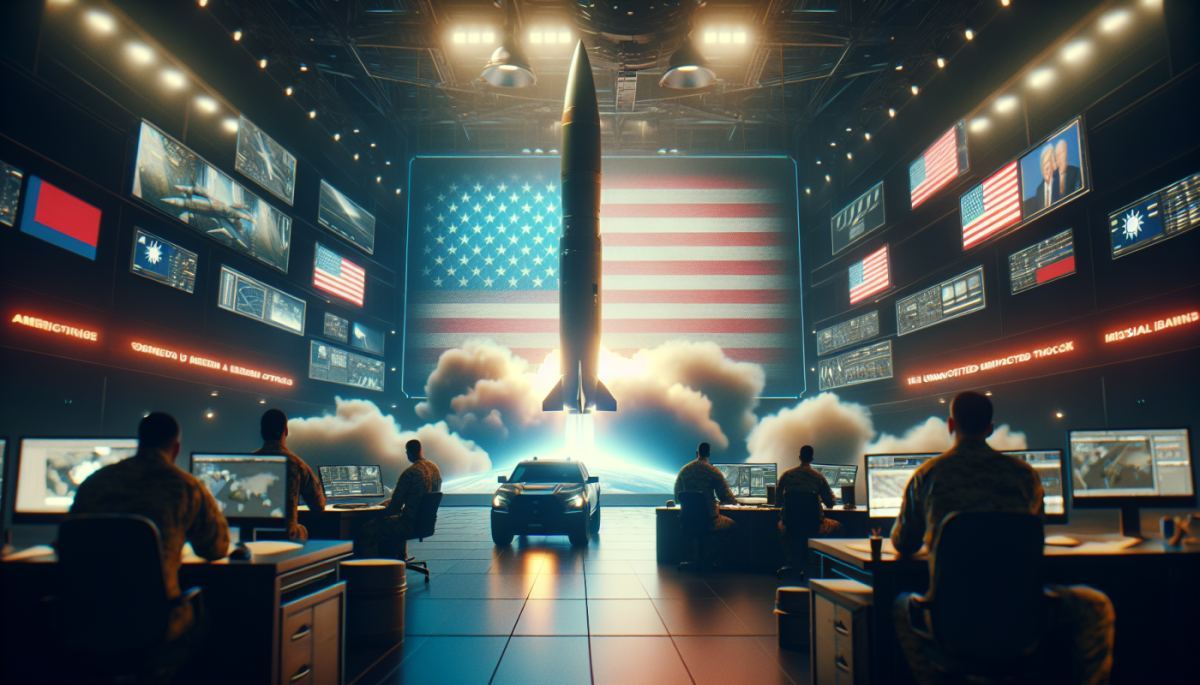
When the United States commits its most advanced munitions to one theater of war, the math in every other theater changes. That is the quiet, uncomfortable calculation now underway in Taipei, where defense planners are watching the Gulf conflict consume weapons that Taiwan considers essential to its own survival in any early confrontation with China.
The concern is not abstract. Specific categories of precision munitions used in operations against Iran overlap directly with the weapons that military strategists have long identified as decisive in the opening hours and days of a Taiwan Strait conflict. These are not interchangeable with older stockpiles. They are the products of years of production ramp-ups that the U.S. defense industrial base has already struggled to sustain, even before a major Gulf engagement entered the equation.
The United States defense industry has been under strain since well before the Iran conflict. The war in Ukraine exposed a structural problem that Washington had spent decades quietly ignoring: American weapons manufacturing was optimized for peacetime procurement cycles, not sustained high-intensity consumption. The Army and Air Force burned through Stinger and Javelin inventories in Ukraine at rates that surprised even senior Pentagon officials, and replenishment timelines stretched into years, not months.
Precision-guided munitions, particularly long-range strike weapons capable of penetrating layered air defenses, sit at the center of this problem. These are exactly the weapons that would matter most in a Taiwan scenario, where the People's Liberation Army has spent two decades building what analysts call an Anti-Access/Area Denial architecture specifically designed to keep U.S. carrier groups and air assets at a distance. Punching through that architecture in the early phase of a conflict requires deep magazines of exactly the munitions now being drawn down in the Gulf.
Taiwan's concern is therefore not simply emotional solidarity with a distant ally. It is a cold-eyed reading of inventory arithmetic. If the weapons that would blunt a Chinese amphibious assault or suppress PLA Air Force operations are sitting at reduced levels in U.S. stockpiles, the deterrence calculus shifts. Beijing's military planners are almost certainly running the same numbers.
There is a systems-level dynamic at work here that rarely surfaces in official statements. American extended deterrence functions partly as a psychological architecture: adversaries are deterred not just by what the U.S. has, but by what they believe the U.S. can sustain. When stockpile depletion becomes visible, even partially, it introduces uncertainty into that psychological structure. Uncertainty, in strategic terms, is not neutral. It can embolden actors who were previously deterred by confidence in American staying power.
This is the second-order consequence that Taiwan's defense community is most alert to. A depleted U.S. munitions inventory does not automatically invite Chinese aggression, but it narrows the margin for error and potentially shortens the window in which American intervention would be decisive. Military analysts have noted that China's optimal moment for action, if it ever chose to act, would be a period when U.S. attention and resources were stretched across multiple simultaneous commitments. The Gulf conflict, whatever its outcome, creates exactly that kind of moment.
The deeper structural issue is that the United States has not yet solved the production problem that Ukraine first made visible. Defense contractors have cited labor shortages, supply chain bottlenecks for specialized components, and the long lead times required to expand manufacturing lines for complex precision weapons. A 2023 Center for Strategic and International Studies analysis found that some critical munitions would take three to five years to replenish even under accelerated production. That timeline does not compress simply because a new conflict demands faster output.
For Taiwan, the practical implication is a renewed urgency around its own indigenous defense production and the diversification of its weapons sources. Taipei has been investing in asymmetric capabilities, including its own cruise missile programs and sea-denial systems, partly in recognition that U.S. support, while essential, cannot be assumed to arrive in unlimited quantities on day one of a conflict. The Iran war has not changed that strategic logic, but it has sharpened it considerably.
What happens next in the Gulf will matter enormously, but so will what happens in American shipyards, munitions plants, and congressional appropriations committees over the next 24 months. The countries watching those processes most carefully may not be in the Middle East at all.
Discussion (0)
Be the first to comment.
Leave a comment