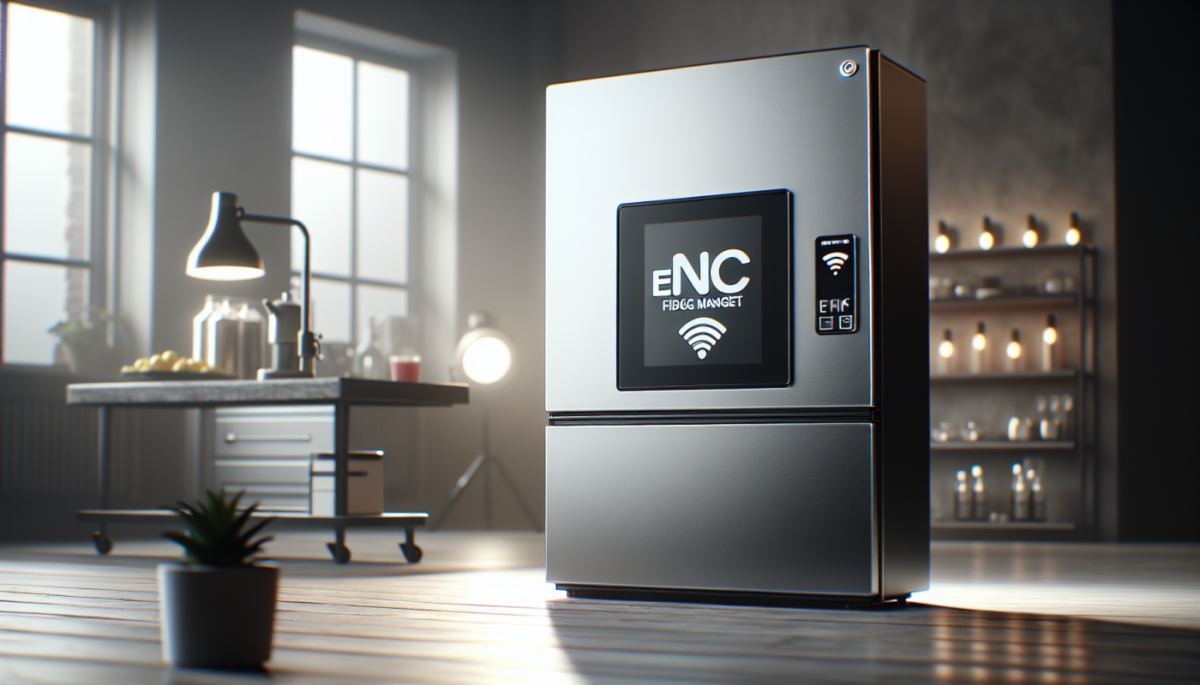
There is something almost poetic about a fridge magnet that never needs batteries. VidaBay's Classic Plus NFC E Ink Fridge Magnet borrows its visual language from the Polaroid photo, that analog artifact of spontaneity and memory, and wraps it around one of the quieter revolutions in display technology. The result is a small, color E Ink screen that updates wirelessly using nothing more than the NFC chip already sitting inside your smartphone. No charging cables. No battery compartment. Just a tap, and the image changes.
The device uses the same low-power color E Ink panels found in the electronic shelf labels now common in grocery stores and big-box retailers. That lineage matters more than it might first appear. Those retail price tags represent one of the most successful deployments of E Ink technology outside of e-readers, and they succeeded precisely because they solved a real operational problem: the staggering labor cost of manually updating thousands of paper price labels across a large store floor. E Ink's defining characteristic, that it only consumes power when the image changes and draws nothing at all while displaying a static image, made the economics work. The same physics that keeps a grocery store's price tag readable for months without a charge is what allows VidaBay's magnet to sit on your refrigerator indefinitely, holding a photo of your dog or your last vacation, without ever asking anything of you.
The trajectory of E Ink as a technology is a useful case study in how industrial applications often precede and fund consumer ones. E Ink Holdings, the Taiwanese company that dominates the market for electrophoretic displays, spent years refining its panels for the e-reader market after Amazon's Kindle popularized the format in 2007. But the real volume, and the real pressure to improve color rendering and reduce per-unit costs, has increasingly come from retail and logistics. Electronic shelf labels alone represent a market projected to surpass $4 billion globally within the next few years, according to industry analysts tracking the sector. That scale of deployment drives manufacturing efficiencies that eventually trickle down into consumer novelties like a Polaroid-shaped fridge magnet.
Color E Ink, which VidaBay's product uses, has historically been the technology's weakest point. Early color implementations using a filter array approach produced images that looked washed out compared to LCD or OLED screens. More recent generations, including the Kaleido and Gallery series panels from E Ink Holdings, have made meaningful progress on saturation and refresh speed, though the displays still cannot match the vibrancy of a smartphone screen. For a fridge magnet meant to display a cherished photograph, that tradeoff is arguably acceptable. The use case does not demand video or animation. It demands something that looks good on a kitchen wall and stays there without complaint.
The NFC power delivery mechanism is the genuinely clever piece of engineering here. Near-field communication chips, the same technology behind contactless payments and transit cards, can harvest a small amount of energy from the electromagnetic field generated by a reader device, in this case your phone. That harvested energy is sufficient to push a new image to the E Ink display, which then holds that image without any further power input. It is a closed loop that sidesteps the battery problem entirely, which is not a trivial achievement in consumer electronics.
The broader implication of products like this one is easy to underestimate. As E Ink panels become cheaper and more capable, and as NFC becomes a standard feature on virtually every smartphone sold, the barrier to embedding a dynamic, low-power display into almost any physical object drops considerably. Picture frames, name badges, book covers, packaging, and architectural surfaces all become candidates. The fridge magnet is a proof of concept disguised as a novelty gift.
What that could eventually mean for how we think about the boundary between digital and physical space is genuinely open. If a static printed surface can be replaced by one that updates silently and without power, the incentive to do so, whether for personalization, advertising, or information display, becomes hard to resist. The grocery store already made that calculation. The kitchen refrigerator is just the next surface in line.
The more interesting question is not whether this technology spreads, but how quickly the design language catches up to the engineering. A Polaroid shape is a deliberate choice, an attempt to make a digital object feel warm and analog. Whether that framing holds as the displays get sharper and the use cases multiply is something worth watching.
Discussion (0)
Be the first to comment.
Leave a comment