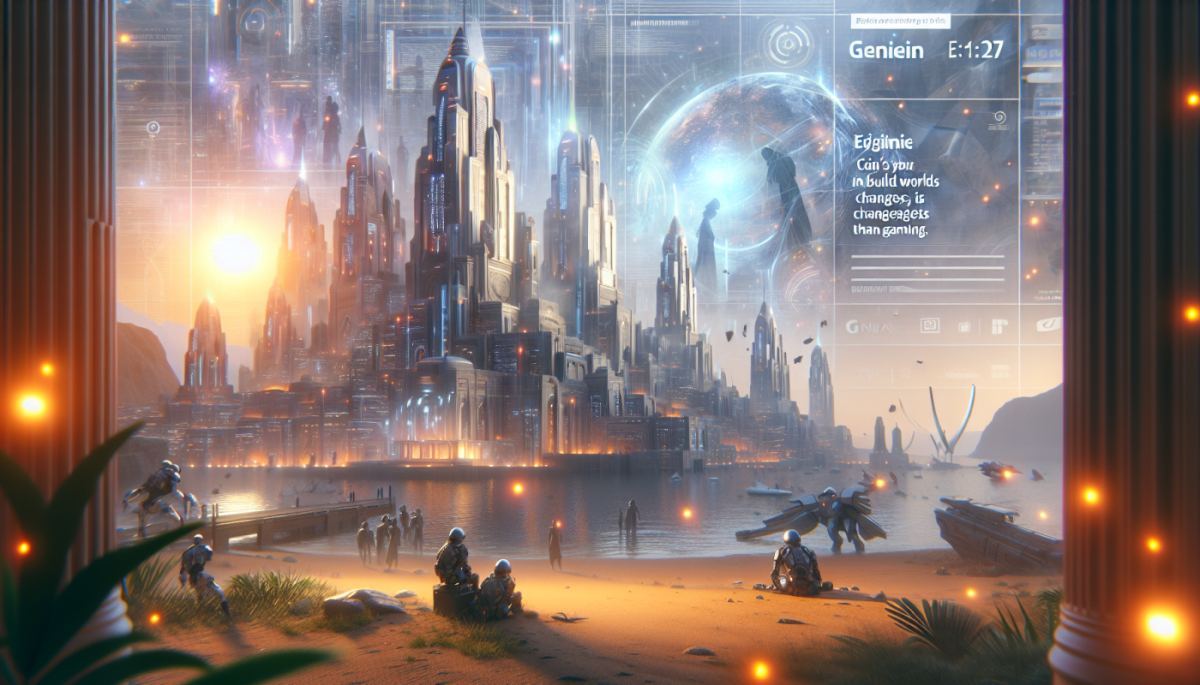
There is a moment, familiar to anyone who has watched a technology mature, when a capability stops being a curiosity and starts being infrastructure. Genie 3, Google DeepMind's latest world model, may have just crossed that threshold. The system can generate dynamic, navigable environments in real time at 24 frames per second, sustaining visual coherence for several minutes at a resolution of 720p. Those are not just impressive benchmark numbers. They represent a qualitative shift in what machine-generated reality can do.
To understand why this matters, it helps to understand what a world model actually is. Unlike a video generator that produces a passive clip, a world model maintains an internal representation of a simulated environment and responds to actions taken within it. You move left, the world updates. You push an object, it reacts. The model is not replaying footage; it is continuously predicting what a coherent physical space should look like given your inputs. Doing that at 24 frames per second, at near-HD resolution, and holding it together for minutes rather than seconds is an engineering achievement that would have seemed implausible just two years ago.
The jump from seconds to minutes of coherent generation is particularly significant. Earlier world models would drift, contradict themselves, or simply collapse into visual noise after a short time. Consistency over longer horizons requires the model to track spatial relationships, object permanence, and environmental logic simultaneously. Genie 3 appears to manage this in a way its predecessors could not, which suggests the underlying architecture has found a more robust way to compress and recall the rules of a generated space.
The obvious first application everyone reaches for is games. Procedurally generated worlds are not new, but a model that can conjure a visually rich, physically plausible environment from a prompt or a sketch, and let you walk through it in real time, compresses what currently takes studios years of asset creation into something closer to a conversation. Independent developers and small teams stand to gain the most from this, since the barrier between imagination and playable prototype could shrink dramatically.
But the more consequential applications may sit further from entertainment. Robotics training is one. Teaching a physical robot to navigate the real world requires enormous amounts of environmental data, and collecting that data in the real world is slow, expensive, and occasionally dangerous. A world model that can generate diverse, consistent, interactive environments at scale becomes a synthetic training ground, a place where a robot can learn to open doors, avoid obstacles, and handle unexpected objects without ever leaving a server rack. The quality of that training depends entirely on how realistic and physically coherent the generated world is. Genie 3's improvements in resolution and temporal consistency move it meaningfully closer to useful.
Architecture and urban planning offer another angle. Designers already use rendering software to visualize spaces, but those tools require manual construction of every asset. A system that can generate a navigable building or streetscape from a description, and let a client walk through it in real time, changes the economics of early-stage design review. The same logic applies to training simulations for emergency responders, virtual heritage preservation, and therapeutic environments in clinical psychology.
The second-order effect worth watching most carefully is not what Genie 3 enables but what it normalizes. When photorealistic, navigable, generated worlds become easy to produce, the cognitive effort required to distinguish the synthetic from the real does not scale with the technology. People are already poorly calibrated at identifying AI-generated images. A world you can walk through, that holds together for minutes, that responds to your movements, will feel real in ways that a static image never quite does. The epistemological pressure this creates on institutions that rely on visual evidence, from courtrooms to journalism to scientific documentation, is not hypothetical. It is a slow-building structural problem that the technology is outpacing.
There is also a subtler feedback loop embedded in the architecture of world models themselves. The better these systems become at simulating reality, the more useful they are for generating training data for other AI systems, which in turn improves the next generation of world models. Genie 3 is not just a product; it is a rung on a ladder that gets easier to climb the higher you go.
The question that will define the next few years is not whether world models can generate convincing environments. Genie 3 has largely answered that. The question is who controls the rules of those worlds, and whether the institutions we rely on to anchor shared reality are moving fast enough to notice.
Discussion (0)
Be the first to comment.
Leave a comment