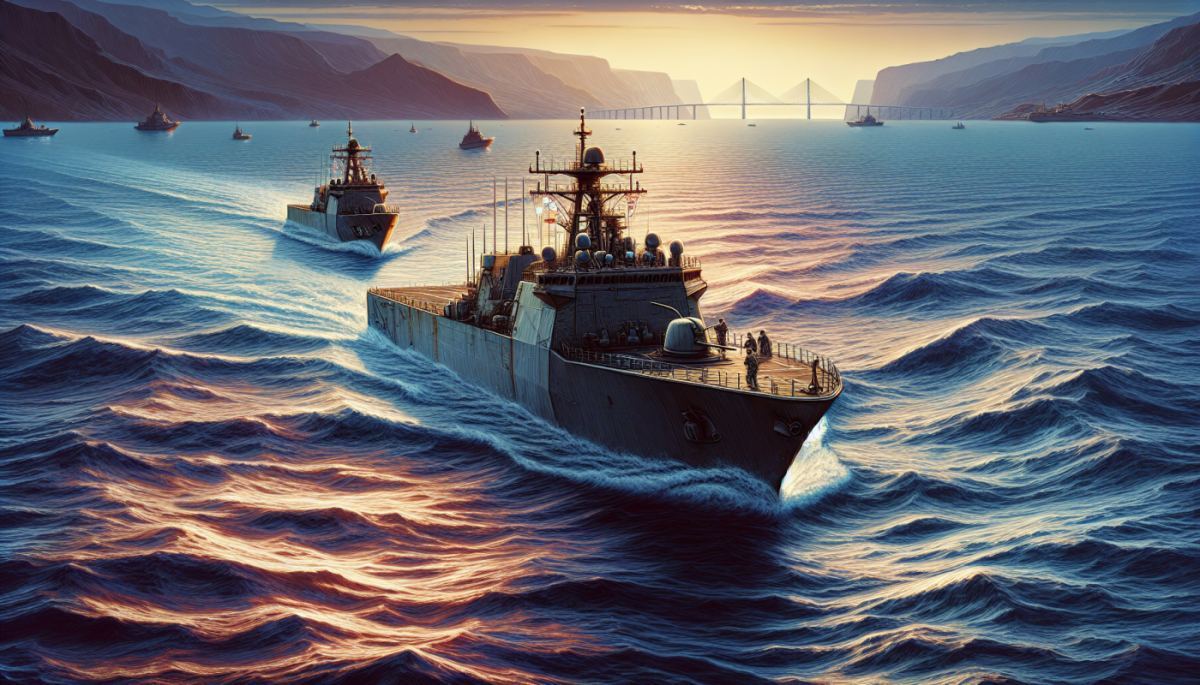
The timing is hard to ignore. Two of the three US Navy minesweepers based in the Persian Gulf are currently docked in Malaysia for what the Navy is calling a "logistical stop," even as Iran has been making increasingly pointed threats about its ability to close the Strait of Hormuz to international shipping. That leaves just one American minesweeper actively positioned in one of the world's most strategically sensitive waterways at a moment when the calculus around naval deterrence is shifting fast.
The Strait of Hormuz is not merely a geographic chokepoint. Roughly 20 percent of the world's oil supply passes through its narrow corridor, and any credible threat to that passage sends tremors through energy markets, insurance underwriters, and the foreign policy establishments of every major importing nation simultaneously. Iran has long understood this leverage. Its military doctrine treats the Strait as a pressure valve, something to threaten when sanctions tighten or diplomatic negotiations stall. The presence of US minesweepers in the region has historically served as a quiet but legible signal that Washington is prepared to keep those lanes open by force if necessary.
Which is what makes the current positioning so worth examining. The Navy's framing of the Malaysia stop as routine logistics may well be accurate. Warships require maintenance, resupply, and crew rest, and Malaysia has long served as a regional hub for exactly that kind of work. But the optics of having two-thirds of your regional minesweeping capacity sitting in a Southeast Asian port while Iran rattles its sabers over Hormuz are not nothing. Perception in naval deterrence is often as consequential as actual capability.
Iran's naval mining capability is not theoretical. During the so-called Tanker War of the 1980s, Iranian mines damaged dozens of vessels in the Gulf, including the USS Samuel B. Roberts in 1988, an incident that triggered Operation Praying Mantis, the largest American surface naval engagement since World War II. The institutional memory of that period shapes how seriously US naval planners take the mine threat, which is precisely why the minesweeper presence in the region was established and maintained in the first place.
Modern naval mines have grown considerably more sophisticated since the 1980s. They can be programmed to respond to specific acoustic or magnetic signatures, meaning they can theoretically be set to target certain classes of vessel while allowing others to pass. Iran is believed to have invested heavily in this capability, and its inventory of sea mines is estimated to number in the thousands. A coordinated mining operation across the Strait's navigable channels would not need to sink ships to achieve its strategic objective. The mere presence of mines, and the uncertainty they create, would be enough to spike insurance premiums, reroute tankers, and send oil prices climbing within hours.
Against that backdrop, the minesweeper is less a weapon than a reassurance mechanism. Its job is to signal that the US can neutralize the threat, which in turn reduces the incentive for Iran to deploy it. Remove that signal, even temporarily, and the deterrence equation shifts in ways that are difficult to fully control.
The deeper systemic consequence here is not about this particular logistical stop. It is about what the episode reveals regarding the strain on US forward-deployed naval assets more broadly. The American military has been managing an extraordinary number of simultaneous commitments, from the Red Sea, where Houthi attacks on commercial shipping have required a sustained carrier and destroyer presence, to the Pacific, where the focus on China continues to pull resources and attention. Minesweepers are not glamorous assets. They are slow, relatively small, and easy to overlook in budget discussions dominated by carriers and submarines. But they are also irreplaceable in the specific scenarios where mines are deployed.
If the US finds itself consistently unable to maintain full minesweeping coverage in the Gulf because assets are stretched or in rotation, adversaries will notice the pattern. Iran's strategic planners are patient and observant. They do not need to act on any single gap. They need only to map the rhythm of American logistics and identify the windows when deterrence is thinnest.
The Malaysia stop may be entirely routine. But routine, repeated often enough, becomes a pattern. And patterns, in the Gulf, have a way of becoming invitations.
Discussion (0)
Be the first to comment.
Leave a comment