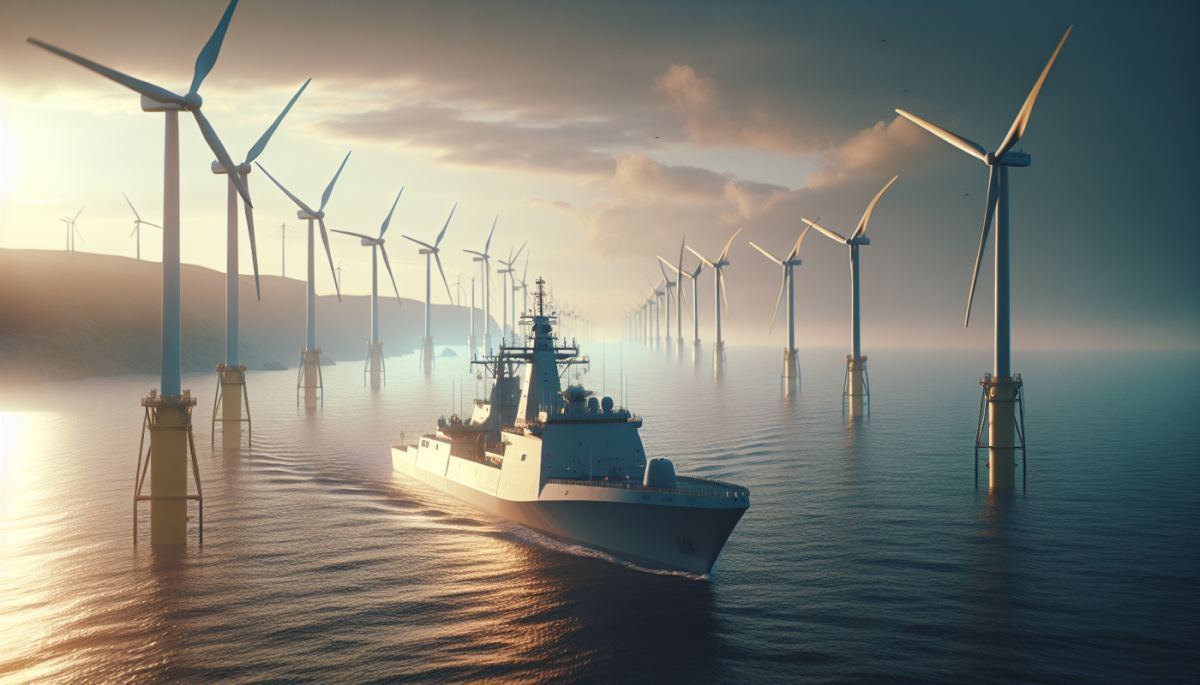
The Trump administration's move to freeze offshore wind construction last year, citing interference with military radar and sonar systems, landed with the rhetorical force of a revelation. Officials framed the tension between turbines and national defense as an urgent, newly discovered problem. But defense planners, engineers, and energy policymakers in Europe, Taiwan, and parts of the United States have been quietly managing exactly these tradeoffs for well over a decade. The framing was politically convenient. The underlying science was not new.
Offshore wind turbines do create real complications for radar systems. Their rotating blades generate what engineers call "clutter," false returns that can obscure aircraft or surface vessels on radar screens. Sonar systems used by naval vessels can similarly be affected by the low-frequency noise generated by turbine foundations and mechanical operations. These are legitimate engineering challenges. But the critical distinction that got lost in the administration's announcement is that "challenge" and "insurmountable threat" are not synonyms.
Countries like the United Kingdom, Denmark, Germany, and the Netherlands have been building offshore wind at scale for years, all while maintaining some of the most sophisticated military radar networks in the NATO alliance. The UK's approach has been particularly instructive. British defense authorities developed a formal process for assessing wind farm proposals against radar coverage maps, requiring developers to fund mitigation measures such as infill radar installations, upgraded signal processing software, and in some cases, redesigned turbine placement to preserve line-of-sight corridors. The result is not a perfect system, but it is a functional one, built through sustained negotiation between energy developers and defense ministries rather than executive freezes.
Taiwan presents perhaps the most striking counterexample to the security-versus-wind framing. Sitting directly in the crosshairs of one of the world's most credible military threats, Taiwan has pressed forward aggressively with offshore wind development. Taiwanese planners have explicitly argued that domestic energy production reduces dependence on fuel imports that could be severed during a blockade, making wind farms a net security asset rather than a liability. The logic is systemic: energy vulnerability is itself a national security risk, and turbines that complicate radar returns may simultaneously reduce the strategic exposure created by fossil fuel dependency.
Some European nations have gone further still, exploring how offshore wind infrastructure might be actively integrated into defense architecture. Platforms that serve as turbine substations can, in theory, also host sensors, communications equipment, or surveillance systems. The North Sea, increasingly dense with wind installations, is being reconsidered not just as an energy corridor but as a potential domain for distributed maritime awareness. The idea that wind farms are inherently incompatible with security is, in this context, almost backwards.
When the administration invoked national security to justify its offshore wind freeze, it triggered a cascade of consequences that extended well beyond any radar interference calculation. Developers who had spent years and hundreds of millions of dollars on permitting, environmental review, and supply chain development faced sudden uncertainty. Some projects were cancelled outright. Others entered legal limbo. The offshore wind supply chain, which had been slowly building domestic manufacturing capacity for turbine components, contracted. Workers trained for specialized installation roles found their near-term employment prospects evaporating.
The second-order effect worth watching is what happens to the United States' long-term position in offshore wind technology. Europe and China have been investing heavily in next-generation turbine design, floating offshore platforms, and grid integration systems. Every year that American developers sit idle is a year that foreign competitors extend their technological lead. If and when U.S. offshore wind development resumes at scale, the country may find itself importing not just components but expertise, paying a premium for knowledge that domestic policy chose to delay acquiring.
There is also a feedback loop embedded in the energy security argument itself. Natural gas and oil infrastructure, the implicit alternative to wind in a freeze scenario, carries its own radar and sonar footprint, its own environmental review requirements, and its own geopolitical vulnerabilities tied to global commodity markets. The security calculus applied to wind turbines was never applied with equivalent scrutiny to the fossil fuel systems they would replace. That asymmetry is not an accident. It reflects which industries have the longer history of shaping the regulatory environment in their favor.
As the offshore wind industry waits for policy clarity, the engineers and defense planners who have actually solved these problems in other countries are not standing still. The question is not whether radar mitigation technology works. It demonstrably does. The question is whether the United States will choose to use it, or spend another decade treating a solved problem as an excuse.
Discussion (0)
Be the first to comment.
Leave a comment