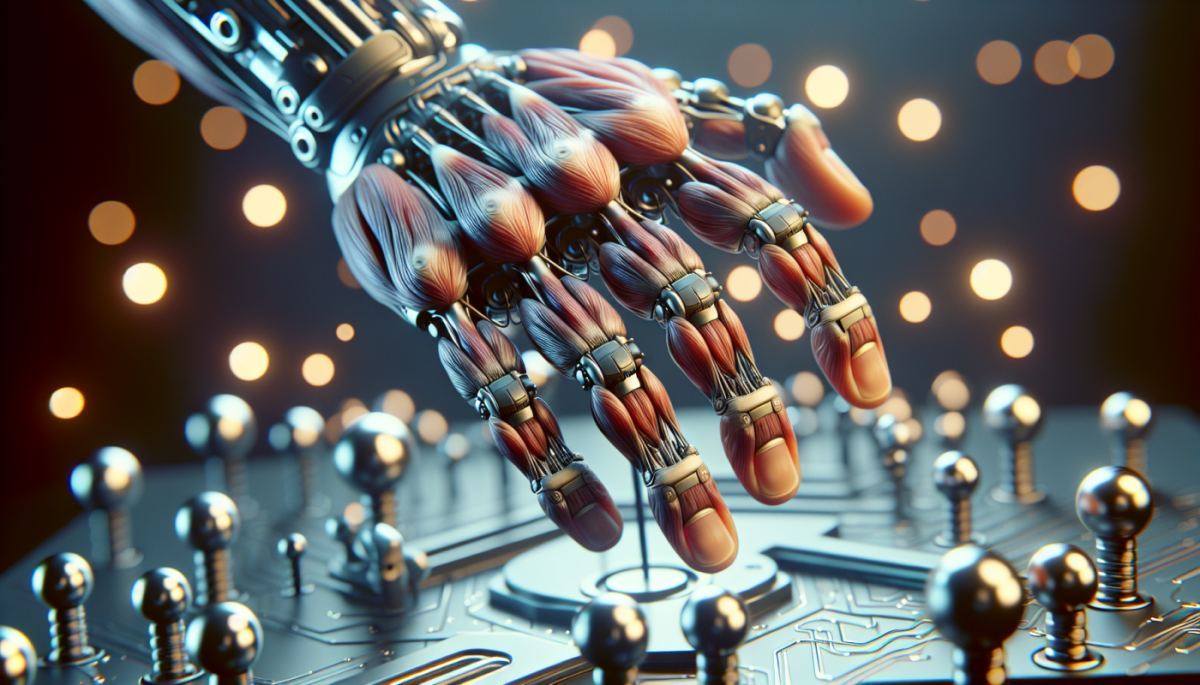
For decades, the robotic hand has been the white whale of mechanical engineering. Researchers have built grippers that can crush, claws that can sort, and arms that can weld with inhuman precision. But replicating the quiet, adaptive intelligence of a human hand — the way it unconsciously adjusts grip pressure when lifting a wet glass, or delicately pinches a grape without bursting it — has remained stubbornly out of reach. A new generation of robot hands built with artificial muscles and tendons is beginning to close that gap, and the implications stretch well beyond the laboratory.
The core challenge has always been biological in nature. Human hands are not simply mechanical systems. They are layered, redundant, and deeply integrated — bones wrapped in tendons, tendons guided by pulleys, muscles firing in coordinated sequences that took millions of years of evolution to refine. Traditional robotics sidestepped this complexity by substituting rigid motors and linkages for soft tissue. The result was capable but brittle: powerful in narrow conditions, helpless outside them. The new approach, which combines soft actuators mimicking muscle tissue with tendon-like transmission systems, attempts to replicate not just the structure of the hand but the functional logic underneath it.
What makes this moment different from earlier attempts at soft robotics is the integration of both soft and rigid components working in concert. Earlier soft robots tended to be entirely compliant, which gave them adaptability but cost them precision and load-bearing capacity. Earlier rigid robots had the opposite problem. The hybrid architecture now emerging — soft artificial muscles driving motion through tendon-like cables anchored to rigid skeletal structures — mirrors what biology actually does. It is not a metaphor for the human hand. It is, in meaningful mechanical terms, an attempt to reproduce its operating principles.
The downstream consequences of a genuinely dexterous robot hand are difficult to overstate. Manufacturing, logistics, surgery, elder care, and disaster response all share a common bottleneck: the tasks that most need automation are precisely the ones that require fine motor control. Warehouse robots today are extraordinarily good at moving boxes but struggle with the irregular, fragile, or oddly shaped objects that human workers handle without thinking. A hand capable of adaptive, tendon-driven grip could unlock automation in product categories — fresh produce, medical devices, artisanal goods — that have resisted it entirely.
The surgical implications are particularly striking. Robotic surgery systems like the da Vinci platform have transformed certain procedures, but they still depend on a surgeon's hands at the controls. A robot hand with genuine dexterity and force sensitivity could eventually operate with greater consistency than a fatigued human surgeon, particularly in prolonged or microsurgical procedures. The regulatory and ethical questions that would follow are enormous, but the technical foundation being laid now is what makes those conversations necessary.
There is also a second-order effect worth watching carefully. As artificial muscle and tendon systems mature, they will generate enormous amounts of data about how biological motion actually works under load, across materials, and at varying speeds. That data feedback loop — from engineered systems back into biological understanding — could accelerate fields like prosthetics, physical rehabilitation, and even our basic science of musculoskeletal biomechanics. The robot hand, in other words, may teach us things about the human hand we did not know to ask.
None of this arrives without friction. Artificial muscles, particularly those driven by pneumatics or electroactive polymers, remain slower, less energy-dense, and less durable than biological muscle. Tendon routing in compact hand geometries introduces mechanical complexity that compounds failure risk. And the control systems required to coordinate multi-finger, multi-joint motion in real time are computationally demanding in ways that make deployment outside research settings genuinely difficult today.
The robotics community has been here before — moments of apparent breakthrough followed by years of grinding engineering work before real-world application catches up. But the convergence of better materials science, more sophisticated machine learning for motor control, and growing commercial pressure from logistics and healthcare industries means the timeline is compressing. ICRA 2026 in Vienna, one of the field's premier research gatherings, will almost certainly feature a wave of work pushing these systems further.
What is most interesting about this moment is not any single robot hand, but the shift in design philosophy it represents. For most of robotics history, engineers asked how to make machines that could do human tasks. The better question, it turns out, was how to make machines that move the way humans move. The answer, biology has been quietly demonstrating all along, involves muscles, tendons, and a great deal of elegant redundancy. Robots are finally starting to listen.
Discussion (0)
Be the first to comment.
Leave a comment