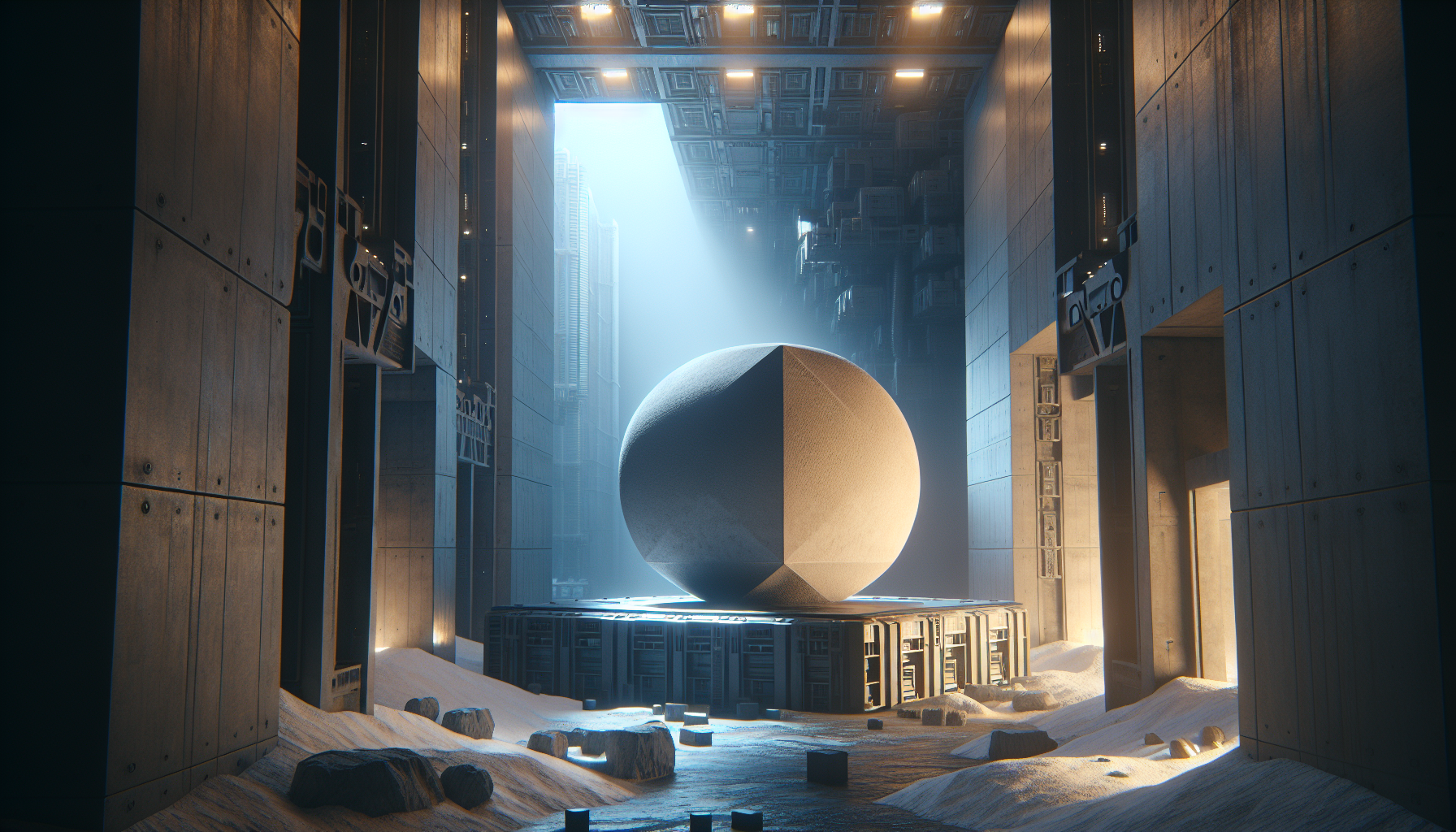
There is something quietly radical about a game that refuses to explain itself. Oeuf, the latest release from the reliably strange mind behind Increpare Games, does exactly that. It wraps a punishing physics platformer inside the most unassuming premise imaginable: you are an egg, and you must move through the world the way eggs actually do, which is to say awkwardly, unpredictably, and with a constant low-grade threat of catastrophe.
The game arrives from Stephen Lavelle, the developer known professionally as Increpare, whose output over the years has been so relentlessly experimental that calling any single title a departure feels meaningless. What makes Oeuf notable is not that it subverts expectations through narrative complexity or borrowed cinematic language. It does the opposite. It strips everything back to a single physical truth: eggs are not round, and that asymmetry is the entire game.
The ovoid shape of an egg is not incidental to Oeuf. It is the engine. Unlike a circle, which rolls with indifferent predictability, an egg wobbles. It resists. It commits to a direction and then quietly betrays you. Lavelle has built a platformer around that resistance, and the result is a game that feels less like a puzzle to be solved and more like a physical argument to be survived.
This design choice sits in sharp contrast to the dominant current in independent game development, where difficulty is increasingly something to be managed, softened, or made optional. Oeuf offers no such accommodation. The challenge is baked into the geometry of the protagonist itself. You cannot separate the player character from the obstacle because they are the same thing.
That is a systems-level insight that most games avoid entirely. In the majority of platformers, the character is a neutral vessel and the environment provides resistance. Here, the resistance is internal. The player must learn to work with a shape that does not want to cooperate, which creates a feedback loop that is genuinely unusual: the better you understand the egg, the more you realize how little control you actually have.
What keeps Oeuf from feeling punitive rather than playful is its visual register. The game presents itself with the soft, rounded aesthetic language that has come to signal safety in contemporary indie games, the same visual grammar used by titles that want to communicate warmth before they communicate challenge. Oeuf borrows that grammar and then quietly undermines it.
This is a more sophisticated move than it first appears. The cozy aesthetic functions as a kind of contract with the player, a promise that the experience will be gentle. Oeuf signs that contract and then enforces different terms. The result is a mild but persistent cognitive dissonance that keeps the player slightly off balance, which is, of course, exactly how an egg moves.
The second-order consequence of this design approach is worth sitting with. If games like Oeuf find an audience, they demonstrate that difficulty and accessibility are not opposites that must be traded against each other. They can coexist in the same object, separated only by the layer of expectation the aesthetic creates. That is a lesson the broader industry, which has spent years debating difficulty settings and accessibility options as if they were the only available tools, has been slow to absorb.
Lavelle has been making games long enough to have watched several cycles of that debate without being particularly moved by any of them. His catalog at increpare.com spans hundreds of releases, many of them free, most of them brief, and nearly all of them interested in the same underlying question: what happens when the rules of a system are the experience, rather than the backdrop for one.
Oeuf is a small game. It does not ask for much of your time. But the question it poses, about what it means to navigate a world when your own shape works against you, has a way of lingering after the game is closed. In a medium that increasingly mistakes scale for depth, that kind of economy is its own form of ambition.



Discussion (0)
Be the first to comment.
Leave a comment