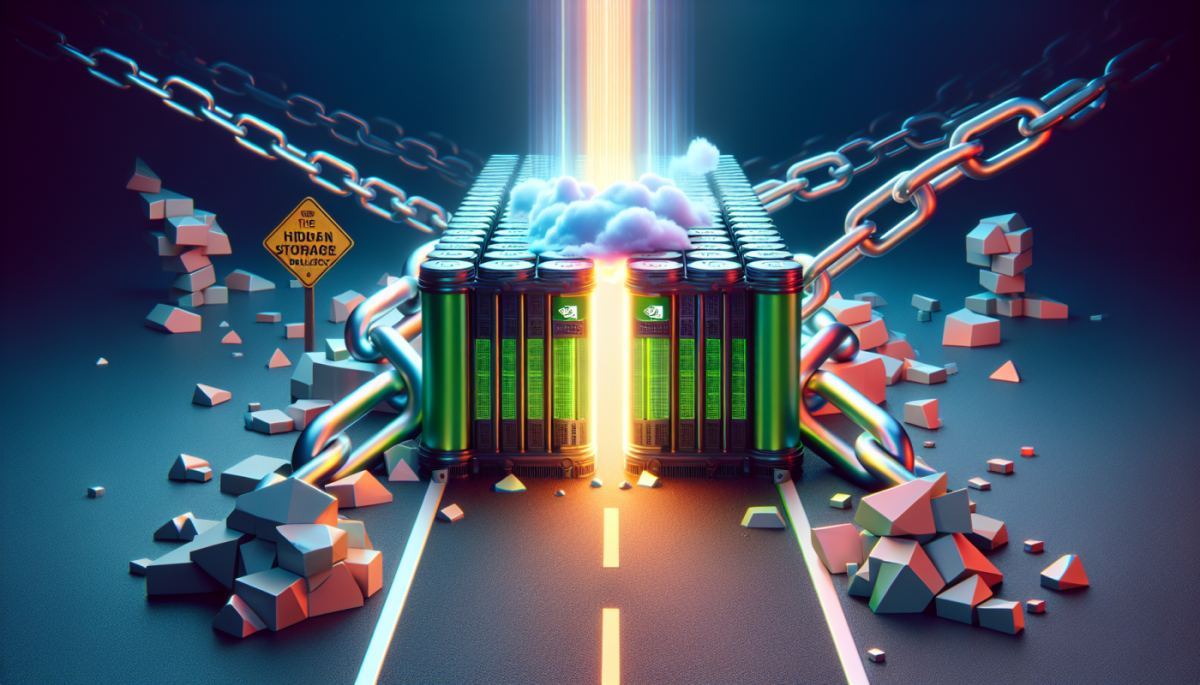
The failure mode is quiet but consequential. An AI agent, midway through a complex multi-step task, loses the thread. It forgets what it was doing, repeats itself, or simply halts. Engineers have spent months blaming the model, tweaking parameters, rewriting prompts. But increasingly, the culprit sits further down the stack, in the unglamorous plumbing between the GPU and the storage system. At GTC 2026, Nvidia made a pointed argument that this is where the real constraint lives, and that BlueField-4 STX is how you fix it.
The announcement centers on a modular reference architecture that inserts a dedicated context memory layer between GPUs and traditional storage infrastructure. The numbers Nvidia is citing are not incremental: 5x the token throughput, 4x the energy efficiency, and 2x the data ingestion speed compared to conventional CPU-based storage approaches. For anyone who has watched GPU utilization graphs flatline while expensive silicon waits for data to arrive, those figures carry real weight.
The specific bottleneck STX targets is key-value cache data, the mechanism by which large language models store and retrieve the context of an ongoing conversation or task. KV cache is the working memory of inference. When an agent is reasoning across a long document, managing a multi-turn conversation, or orchestrating a chain of tool calls, the KV cache is what keeps it coherent. The problem is that as context windows have grown from thousands to hundreds of thousands of tokens, the data volumes involved have ballooned accordingly. Traditional storage architectures, designed around CPU-centric assumptions about how data moves, were never built for this kind of access pattern. The result is a throughput gap that grows wider every time a model gets more capable.
What makes the STX approach architecturally interesting is the decision to treat context memory as a distinct layer rather than trying to squeeze more performance out of existing tiers. By positioning a dedicated layer between the GPU and conventional storage, Nvidia is essentially arguing that the memory hierarchy itself needs to be redesigned for the agentic workload, not just upgraded. This is a systems-level claim, not a component-level one, and it reflects a broader shift in how the industry is beginning to think about AI infrastructure. The GPU is no longer the only thing that matters. The entire data path matters.
The energy efficiency argument is perhaps underappreciated in the coverage this announcement will receive. A 4x improvement in energy efficiency at the storage layer compounds across a data center in ways that are easy to underestimate. Hyperscalers running inference at scale are not just constrained by compute budgets; they are constrained by power budgets, cooling capacity, and increasingly by the political and regulatory scrutiny that comes with operating facilities that consume as much electricity as small cities. An architecture that delivers the same throughput at a fraction of the energy cost does not just save money on electricity bills. It changes what is physically possible within a given facility footprint.
The cascading consequence worth watching here is what this does to the competitive dynamics of agentic AI deployment. Right now, the organizations best positioned to run sophisticated long-context agents at scale are those with the deepest pockets and the most custom infrastructure. If BlueField-4 STX delivers on its throughput and efficiency claims, it potentially lowers the infrastructure barrier for mid-tier cloud providers and enterprise operators who have been priced out of serious agentic workloads. That democratization effect, if it materializes, could accelerate adoption of multi-agent systems in sectors like healthcare, legal, and financial services, where the use cases are compelling but the infrastructure costs have been prohibitive.
There is also a second-order effect on model development itself. When storage throughput is the binding constraint, model architects face pressure to keep context windows artificially short or to design around the limitation in ways that compromise capability. Remove that constraint, and the design space opens up. Researchers who have been holding back on long-context architectures because the serving infrastructure could not support them may find new room to experiment.
Nvidia has spent the past three years making the case that it sells not just chips but platforms, and BlueField-4 STX is a continuation of that argument extended into the storage domain. Whether the architecture becomes a standard reference point for inference infrastructure or remains a niche solution for the most demanding deployments will depend on adoption curves that are impossible to predict from an announcement alone. But the underlying diagnosis, that agentic AI has a storage problem that no amount of model improvement will solve, is one the industry is going to have to reckon with regardless of which hardware ends up addressing it.
Discussion (0)
Be the first to comment.
Leave a comment