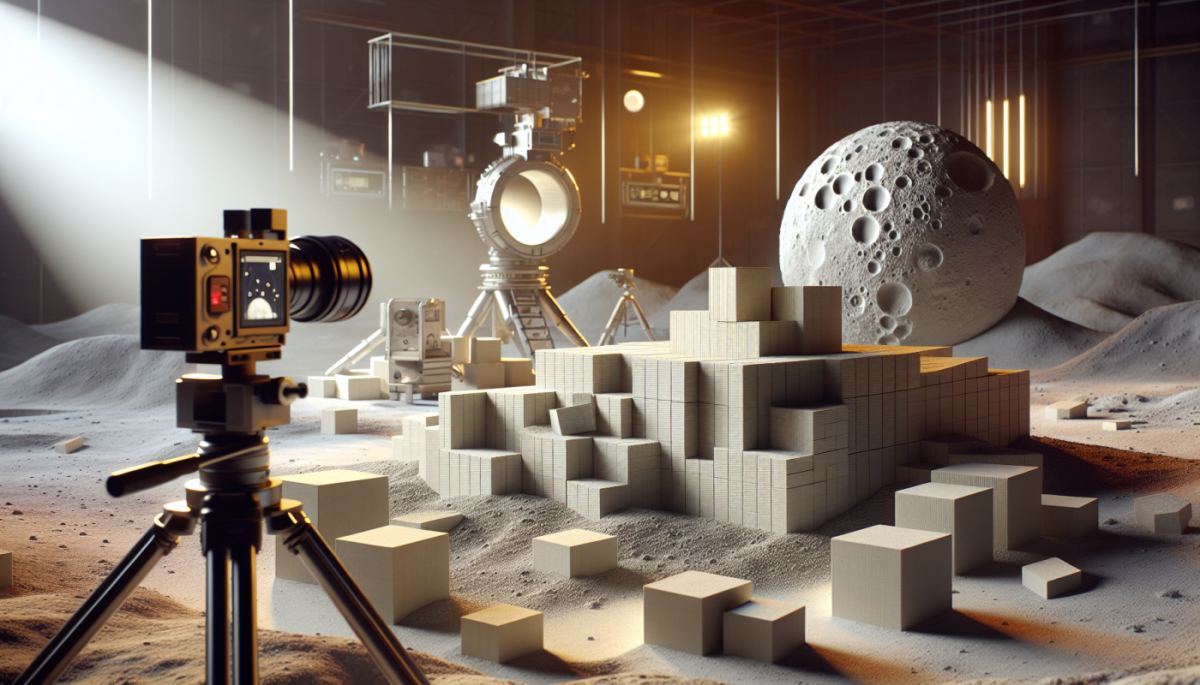
The race to establish a permanent human presence on the Moon is no longer a distant aspiration. Through the Artemis Program, NASA is actively working toward building a base near the lunar south pole, a region defined by its permanently shadowed craters and the water ice locked within them. China, Russia, and the European Space Agency have parallel ambitions, all converging on the same forbidding terrain: the South Pole-Aitken Basin. What unites these programs beyond geopolitical competition is a shared logistical reality — you cannot build a Moon base by shipping everything from Earth. The math simply does not work. Every kilogram launched into deep space costs a fortune, and resupply missions take days to weeks even under ideal conditions. That constraint is forcing engineers to think differently about construction itself.
The answer gaining serious traction is laser-based 3D printing, a process that uses concentrated beams of light to fuse lunar regolith — the loose, fine-grained soil blanketing the Moon's surface — into solid structural material. The concept is elegant in its logic: instead of importing bricks, steel, or concrete, future lunar inhabitants would harvest the ground beneath their feet and print whatever they need. Regolith is abundant, it requires no mining in the traditional sense, and it is already sitting at the construction site. The challenge has always been turning that raw material into something structurally reliable, and laser sintering is emerging as one of the most promising methods for doing exactly that.
Sintering is a process where heat is applied to a powdered material just below its melting point, causing particles to bond without fully liquefying. When a high-powered laser is directed across a thin layer of regolith, it can fuse those particles into a dense, ceramic-like solid. Layer by layer, complex geometries become possible — walls, support struts, radiation shielding panels, even habitat modules. Researchers have been experimenting with lunar regolith simulants, materials engineered on Earth to approximate the chemical and physical properties of actual Moon soil, and early results suggest the process can produce structures with meaningful compressive strength.
What makes the lunar south pole particularly significant here is not just the water ice, though that matters enormously for life support and fuel production. The region also receives near-continuous sunlight along certain ridgelines — the so-called peaks of eternal light — which means solar energy could power the laser systems needed for construction without relying on nuclear reactors or heavy battery arrays shipped from Earth. That feedback loop is worth sitting with: sunlight powers the lasers, lasers fuse the soil, fused soil builds the shelter that protects humans from radiation and temperature extremes, and those humans can then operate and expand the system further. It is one of the few genuinely self-reinforcing construction cycles ever proposed for off-world environments.
The implications extend well beyond construction timelines. If laser sintering proves reliable at scale, it fundamentally changes the economics of lunar settlement in ways that ripple back to Earth. Space agencies and private companies currently spend enormous resources on payload mass optimization — every design decision on a crewed mission is shaped by the tyranny of launch weight. A credible in-situ manufacturing capability loosens that constraint, which in turn opens the door to more ambitious mission profiles, longer crew rotations, and eventually permanent rather than rotating habitation.
There is also a geopolitical dimension that deserves attention. The nations and agencies racing toward the lunar south pole are not simply chasing scientific prestige. Water ice is a strategic resource — it can be split into hydrogen and oxygen, producing rocket propellant that could make the Moon a refueling depot for deeper space missions. Whoever establishes durable, self-sufficient infrastructure near those permanently shadowed craters first will have a structural advantage that compounds over time. Laser-printed regolith structures are not just buildings; they are the physical expression of staying power.
The second-order effect most likely to be underestimated is the knowledge transfer back to Earth. Techniques developed to print structures from dry, unprocessed powder in a vacuum, under radiation, with no supply chain, will almost certainly find applications in terrestrial disaster response, remote construction, and materials science. The Moon, in this sense, is not just a destination. It is a laboratory for building under impossible conditions — and the lessons learned there may reshape how we think about construction on the planet we already live on.
Discussion (0)
Be the first to comment.
Leave a comment