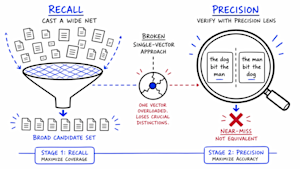
Enterprise AI teams chasing better accuracy in their retrieval-augmented generation pipelines may be engineering a subtle form of self-sabotage. New research from Redis reveals that training embedding models to distinguish between nearly identical but semantically different sentences — a capability called compositional sensitivity — can reduce overall retrieval accuracy by as much as 40%. For organizations building agentic AI systems that depend on reliable information retrieval, that tradeoff is far from trivial.
The paper, "Training for Compositional Sensitivity Reduces Dense Retrieval Generalization," examines what happens when teams optimize their embedding models to catch fine-grained linguistic distinctions. Think of sentences like "the dog bit the man" versus "the man bit the dog" — same words, radically different meanings. Teaching a model to reliably separate those cases sounds like a reasonable engineering goal. The problem is that the training process required to achieve that sensitivity appears to come at a steep cost to the model's broader ability to retrieve relevant documents across diverse queries.
This is a classic systems-level tension: optimizing one part of a pipeline for local performance degrades the global behavior of the whole system. In retrieval-augmented generation, the embedding model is not a standalone component. It is the foundation on which everything else rests. When an agent queries a knowledge base, the embedding model determines what information even enters the context window. A 40% drop in retrieval accuracy does not just mean slightly worse answers — it means the model is routinely surfacing the wrong documents, which then propagate errors forward through every subsequent reasoning step.
The appeal of compositional sensitivity training is understandable. As enterprises deploy RAG systems in higher-stakes environments — legal research, medical documentation, financial compliance — the cost of a model conflating two superficially similar but meaningfully different passages grows considerably. A contract clause that says a party "shall not" versus "shall" be liable is exactly the kind of distinction that could matter enormously in practice. So teams reach for fine-tuning as a solution, and the benchmarks often reward them for it.
But benchmarks are narrow. They measure what they measure. The Redis findings suggest that the training signal used to sharpen compositional sensitivity is pulling the embedding space in a direction that hurts generalization — the model's ability to handle the messy, varied, unpredictable queries that real users actually submit. This is not a new phenomenon in machine learning. It echoes the well-documented problem of shortcut learning, where models latch onto surface-level patterns that score well on training distributions but fail on anything slightly outside them. What makes this case particularly sharp is that the failure mode is invisible during development. Teams see improved precision scores and ship the model. The degradation only surfaces in production, where query distributions are broader and harder to anticipate.
For agentic pipelines specifically, the consequences compound. A single RAG call gone wrong in a multi-step agent workflow does not just produce one bad answer — it can send the entire reasoning chain down a wrong path, with each subsequent step building confidently on a flawed foundation. The agent has no way of knowing the retrieval failed. It proceeds as if the context it received is correct.
The Redis research arrives at a moment when enterprise adoption of agentic AI is accelerating rapidly. Organizations are moving from experimental chatbots toward systems that take actions, write code, query databases, and make decisions with limited human oversight. The reliability of the retrieval layer in those systems is not an academic concern — it is an operational one.
The deeper implication here is about how AI infrastructure gets evaluated. Most enterprise teams assess their embedding models on narrow, task-specific benchmarks before deployment. The Redis findings suggest that evaluation suites need to be broader and more adversarial, explicitly testing whether precision gains on one dimension are being purchased with generalization losses on another. Without that kind of systemic evaluation, teams will keep making locally rational decisions that produce globally fragile systems.
There is also a second-order effect worth watching. As more organizations fine-tune open-source embedding models on proprietary data and deploy them inside agentic workflows, the diversity of embedding behaviors across the industry will grow. Two organizations using the same base model but different fine-tuning regimes may end up with retrieval systems that behave in fundamentally incompatible ways — a fragmentation that could complicate benchmarking, vendor comparisons, and even regulatory audits of AI-assisted decisions.
The race to make AI systems more precise is not going to slow down. But precision that quietly hollows out the reliability of the systems it inhabits is not really precision at all.
References
- Redis AI Research (2024) — Training for Compositional Sensitivity Reduces Dense Retrieval Generalization
- Guu et al. (2020) — REALM: Retrieval-Augmented Language Model Pre-Training
- Lewis et al. (2020) — Retrieval-Augmented Generation for Knowledge-Intensive NLP Tasks
- Geirhos et al. (2020) — Shortcut Learning in Deep Neural Networks
Discussion (0)
Be the first to comment.
Leave a comment