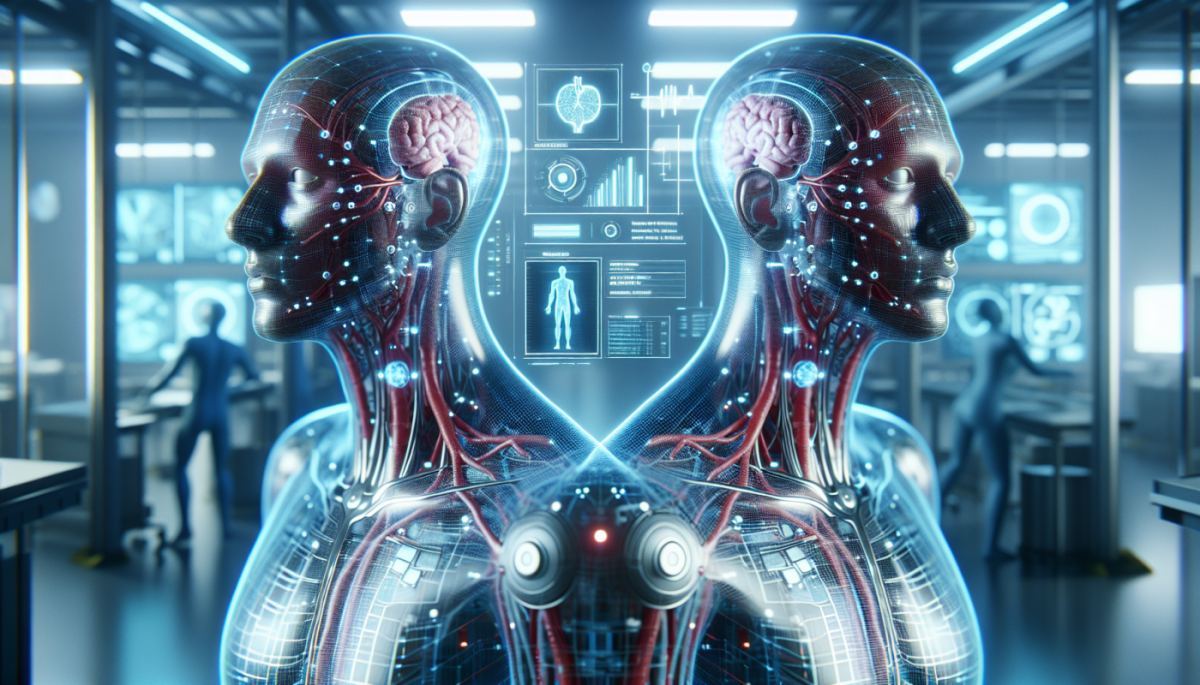
A cardiac surgeon at Boston Children's Hospital walked into an operating room in May 2019 carrying something no instrument tray could hold: certainty. Before making a single incision to rebuild a child's heart, he had already performed the procedure dozens of times in a virtual environment modeled precisely on that specific patient's anatomy. He knew which approach would work. He knew which ones wouldn't. The child on the table was, in a meaningful sense, not the first version of themselves he had operated on.
That moment represents something quietly revolutionary in medicine. The technology behind it, broadly called a "digital twin," has existed in industrial engineering for years. Aerospace companies build virtual replicas of jet engines to simulate stress and failure before a single bolt is tightened. NASA has used the concept to model spacecraft systems in real time. But the migration of this logic into human biology, where the "system" being modeled is a living, breathing child with a malformed heart, marks a genuinely different frontier.
A digital twin in the medical context is not simply a 3D scan or a simulation. It is a dynamic, data-rich computational model that mirrors an individual patient's physiology with enough fidelity to test interventions before they are applied to the real body. The distinction matters enormously. A static image tells a surgeon what a heart looks like. A digital twin can tell them how it will behave under specific surgical conditions, what the pressure gradients will be after a repair, and which of several viable strategies is most likely to produce a stable outcome.
Building a useful digital twin requires layering multiple data streams: imaging data, hemodynamic measurements, genetic information, and increasingly, real-time physiological signals. The computational demands are significant, and the models are only as good as the data fed into them. This is where the systems complexity becomes apparent. Medicine has historically generated enormous quantities of patient data, but that data has lived in silos, formatted inconsistently, and governed by privacy frameworks that make aggregation difficult. The promise of digital twins depends heavily on solving problems that are not primarily technological but institutional and political.
There is also the question of validation. A simulation is persuasive only if clinicians trust it, and trust requires evidence that the virtual predictions actually correspond to real-world outcomes. Building that evidence base takes time, large patient cohorts, and the kind of longitudinal follow-up that healthcare systems are not always structured to support. The surgeon at Boston Children's Hospital had confidence in his virtual rehearsals, but that confidence was built on a foundation of prior work, calibration, and clinical judgment that cannot be shortcut.
Still, the trajectory is clear. Researchers at institutions including the Cardiovascular Research Foundation and groups affiliated with the European Commission's Virtual Physiological Human initiative have been pushing the boundaries of what patient-specific modeling can do. Pharmaceutical companies have begun exploring digital twins as a way to reduce the cost and duration of clinical trials, running virtual cohorts alongside real ones to identify signals faster. The FDA has acknowledged the concept in its framework for computational modeling in medical device submissions.
The most underappreciated consequence of widespread medical digital twins may not be surgical precision. It may be what happens to medical liability, insurance underwriting, and the definition of informed consent when a patient's virtual self can be interrogated before any treatment begins. If a digital twin predicts a 23 percent chance of a specific complication, and that complication occurs, the legal and ethical terrain shifts in ways that courts and regulators have barely begun to map.
There is also a distributional question that deserves more attention than it typically receives. Digital twins require computational infrastructure, specialized expertise, and high-quality input data. The patients most likely to benefit first are those treated at well-resourced academic medical centers in wealthy countries. The gap between institutions that can deploy this technology and those that cannot could become another axis along which health outcomes diverge, layering a new form of inequality onto existing ones.
What the Boston Children's Hospital case illustrates, at its core, is that the value of a digital twin is not just predictive. It is also psychological and procedural. A surgeon who has rehearsed a complex repair dozens of times in a virtual environment is a different surgeon than one who has not, regardless of how accurate the simulation is. That shift in preparation culture, if it scales, could change surgical training, credentialing, and the entire apprenticeship model that medicine has relied on for generations. The operating room of the future may be one where the most important work happens before anyone scrubs in.
References
- Niederer et al. (2021) — Scaling digital twins from the artisanal to the industrial
- Björnsson et al. (2019) — Digital twins to personalize medicine
- U.S. Food and Drug Administration (2021) — Assessing the Credibility of Computational Modeling and Simulation in Medical Device Submissions
- Corral-Acero et al. (2020) — The 'Digital Twin' to enable the vision of precision cardiology
Discussion (0)
Be the first to comment.
Leave a comment