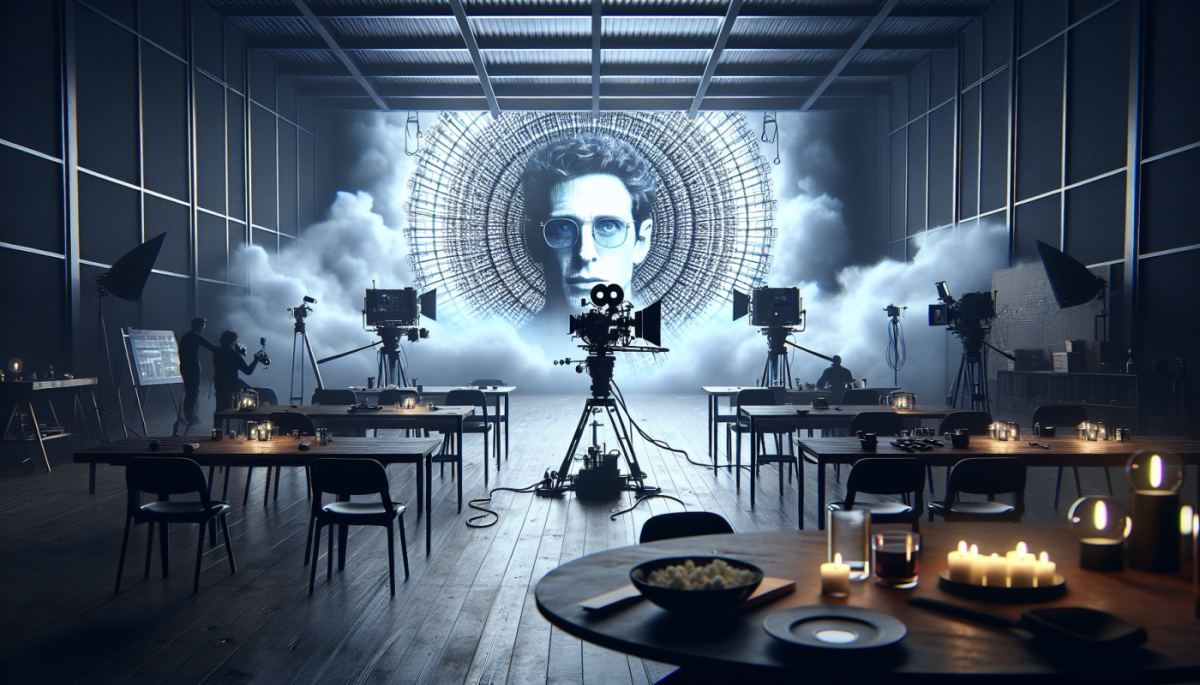
There is a moment in almost every technological disruption when the avant-garde and the commercial collide, and what emerges is something neither camp fully anticipated. That moment may have arrived for cinema. Google's Veo, the company's flagship AI video generation model, has now been used as a core creative tool in a film called ANCESTRA, made in collaboration with director Darren Aronofsky and filmmaker Eliza McNitt, supported by a production team of more than 200 people. The project is not a gimmick, and it is not a proof-of-concept demo reel. It is a genuine attempt to fuse AI-generated imagery with live-action filmmaking at a level of artistic seriousness that the industry has rarely seen applied to this technology.
Aronofsky, whose filmography runs from the claustrophobic dread of Requiem for a Dream to the mythological scale of Noah, is not someone who reaches for new tools casually. His involvement signals something important: that Veo has crossed a threshold of quality and controllability that makes it usable not just by technologists experimenting on the margins, but by directors who have spent careers obsessing over the precise texture of an image. McNitt, known for her immersive documentary work and her long-standing interest in the intersection of science and storytelling, brings a different but complementary sensibility. Together, they represent a creative pairing that takes the experiment well beyond novelty.
What makes ANCESTRA particularly significant from a systems perspective is the scale of human collaboration that surrounded the AI tooling. More than 200 people worked on this production. That number matters because it dismantles one of the most persistent anxieties circulating through Hollywood right now, which is the fear that AI video generation is primarily a displacement technology, a way to do more with fewer people. The reality demonstrated here is more complicated and, in some ways, more interesting. Veo appears to have functioned not as a replacement for human craft but as an expander of what was visually possible within a given budget and timeline, with human artists, editors, and production staff shaping, directing, and contextualising everything the model generated.
This is the feedback loop that tends to get lost in the broader cultural panic about AI and creative work. When a sufficiently powerful generative tool enters a production pipeline, it does not simply subtract labour. It changes the nature of the decisions that humans are asked to make. Cinematographers, production designers, and visual effects artists are no longer only executing a vision within hard physical constraints. They are increasingly curating, directing, and refining outputs from systems that can generate at a speed and volume no human team could match. The skill set shifts. The creative conversation shifts. And the kinds of stories that become financially viable to tell shift with it.
The second-order consequences of a project like ANCESTRA are worth sitting with carefully. If a film of this artistic pedigree demonstrates that Veo can be integrated into serious, auteur-driven work without compromising creative integrity, it will accelerate adoption across the industry far more effectively than any number of corporate demonstrations or benchmark comparisons. Other directors will watch. Studios will take note. Financiers who have been cautious about backing visually ambitious projects because of cost will begin to recalculate. The barrier between what a mid-budget film can look like and what a blockbuster can look like will continue to compress.
There is also a subtler cultural consequence worth naming. Aronofsky and McNitt are not just making a film. They are, whether they intend to or not, providing a kind of ethical and aesthetic template for how AI tools can be used in ways that centre human authorship rather than obscure it. The 200-person team is not incidental to the story. It is the story. It suggests a model of AI-assisted filmmaking that preserves creative agency, distributes labour in new but not necessarily diminished ways, and treats the technology as a collaborator rather than a shortcut.
The question the industry will spend the next several years answering is whether that model holds as the economics intensify and the pressure to cut costs grows louder. ANCESTRA offers a hopeful data point. Whether it becomes a precedent or an exception depends entirely on the choices that come next.
Discussion (0)
Be the first to comment.
Leave a comment