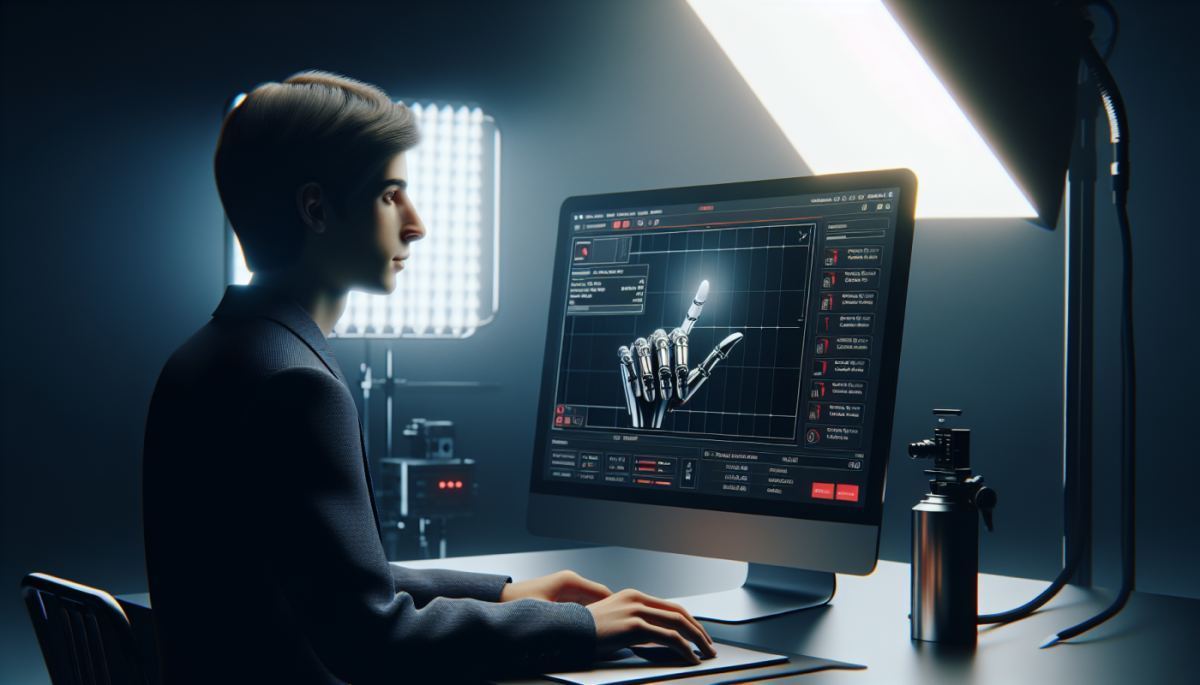
Anthropic's Claude can now move your cursor, click buttons, open applications, and type into fields on your Mac, all without you touching the keyboard. Released Monday as a research preview for paying subscribers, the feature transforms Claude from a conversational assistant into something closer to a remote digital operator sitting invisibly at your desk. It is the most ambitious consumer AI agent deployment to date, and it signals that the race to build AI that actually does work, rather than just talks about it, has entered a new and consequential phase.
The timing is not accidental. For the past two years, the dominant narrative around large language models has been about what they know. Now the competitive frontier has shifted decisively toward what they can do. OpenAI has been building out its own agentic capabilities, Google has Gemini threading through its productivity suite, and a wave of startups are pitching AI agents to enterprise customers. Anthropic, which has positioned Claude as the more careful and safety-conscious alternative, is now making clear that caution does not mean slow. Launching computer-use capabilities directly inside a consumer product, before most rivals have done the same at scale, is a calculated move to claim territory.
What makes computer-use agents genuinely different from chatbots is the feedback loop they create between instruction and action. A chatbot responds. An agent acts, observes the result, and acts again. When Claude is given a task on your Mac, it is not executing a pre-written script. It is reading the screen, making decisions about what to click or type, checking whether the outcome matched its expectation, and then continuing or correcting. That loop is what makes agents feel qualitatively different from anything that came before, and it is also what makes them harder to audit.

The research preview label matters here. Anthropic is being transparent that this is not a finished product, which is consistent with the company's stated commitment to iterative, safety-focused deployment. But research previews have a way of becoming defaults. Users adapt their workflows around new capabilities quickly, and once a tool is embedded in daily habit, rolling it back becomes socially and commercially costly. The preview framing may be genuine, but it also functions as a soft launch that lets Anthropic gather real-world data on how people delegate tasks to an AI operating inside their most personal computing environment.
The second-order consequence worth watching is what this does to software design. Applications have historically been built for human hands, with interfaces that assume a person is reading, deciding, and clicking. If AI agents become a significant portion of the "users" interacting with software, developers will face pressure to build machine-readable interfaces alongside human ones, essentially a new layer of API-like structure embedded in consumer apps. That shift could quietly reshape how software is designed, tested, and monetized over the next decade.
There is a deeper tension running beneath the convenience narrative. When Claude clicks a button on your behalf, who is responsible for what happens next? If it deletes a file, sends an email prematurely, or misreads a form field and submits incorrect information, the liability question is genuinely unresolved. Anthropic's terms of service will carry some of that weight, but terms of service are not the same as clear legal frameworks, and regulators in the U.S. and Europe are still catching up to agentic AI.
Anthropics own research has been unusually candid about the risks of agentic systems. The company's published work on model behavior acknowledges that agents operating over long time horizons with real-world consequences require different safety considerations than single-turn conversations. Giving Claude access to your Mac is, in effect, a live test of those considerations at consumer scale.
There is also a subtler psychological dimension. Delegation is a form of trust, and trust, once extended, tends to expand. Users who become comfortable letting Claude handle routine tasks will gradually hand over more complex ones. That is not necessarily bad, but it means the boundaries of AI agency in daily life will be set less by deliberate policy than by the slow accumulation of small conveniences. The companies building these tools understand this dynamic well. The users living inside it may not.
What Anthropic has launched is not just a feature. It is a new model of human-computer interaction, one where the human increasingly sets the goal and the machine navigates the path. How far that model extends, and who gets to define its limits, is the question that will shape computing for years to come.
Discussion (0)
Be the first to comment.
Leave a comment