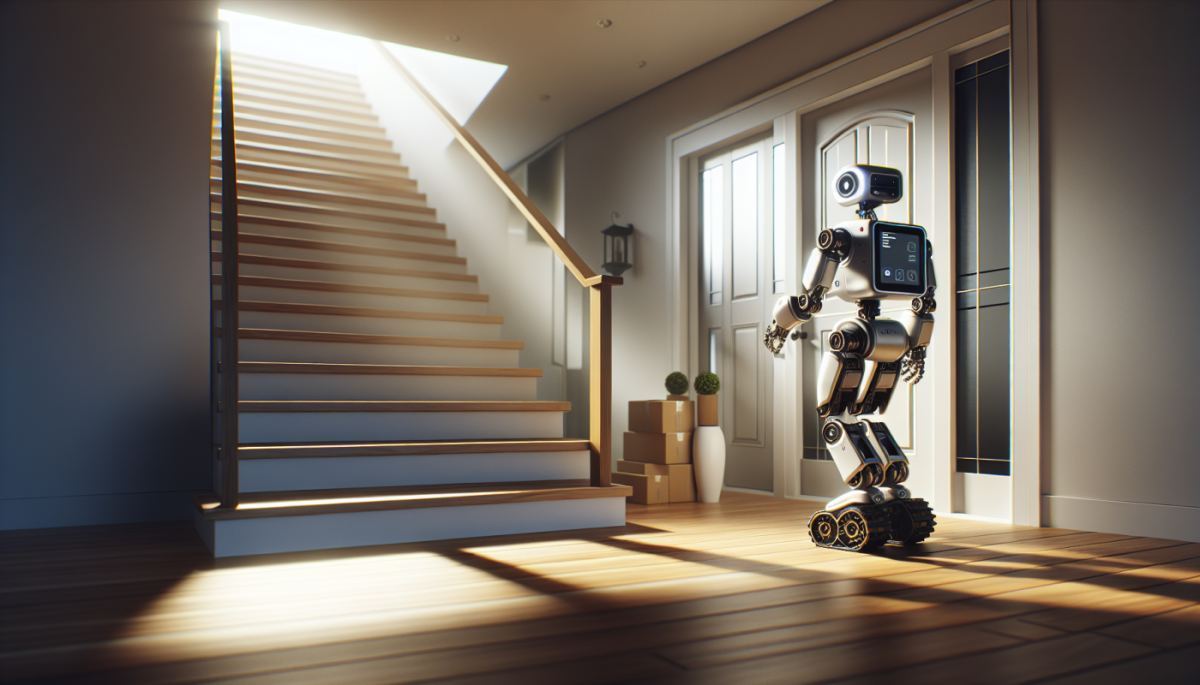
Amazon has acquired Rivr, a startup that builds stair-climbing delivery robots, in a move that sharpens the company's long-running ambition to own the final few feet of the delivery chain. The deal is notable not only for what it adds to Amazon's logistics arsenal, but for what it reveals about where the company believes the real friction in last-mile delivery still lives: not on the road, not at the warehouse dock, but on the front porch steps.
Both Amazon and Jeff Bezos had previously invested in Rivr before the outright acquisition, a pattern that has become something of a playbook in the company's approach to emerging logistics technology. Seed the startup, watch it develop, absorb it once the technology matures enough to integrate at scale. It is a lower-risk path to hardware innovation than building in-house from scratch, and it keeps promising teams from landing at competitors.
Rivr's core technology addresses a problem that has quietly frustrated autonomous delivery for years. Ground-level robots, drones, and autonomous vehicles can navigate sidewalks and streets with increasing competence, but stairs remain a stubborn physical barrier. Most residential addresses in the United States involve at least a few steps between the street and the front door, and in dense urban environments, that number climbs considerably. A robot that cannot climb stairs cannot actually complete a doorstep delivery. It can only complete a curb delivery, which still requires a human to close the gap.
The economics of last-mile delivery have been under pressure for years. According to research from the Business Insider Intelligence unit, last-mile delivery accounts for more than 50 percent of total shipping costs, and that share has been rising as consumer expectations for speed and precision increase. Amazon has invested heavily in reducing those costs through its own delivery network, drone programs like Prime Air, and sidewalk robots like Scout, which was quietly wound down in 2022 after limited success. Scout's failure was instructive: a robot that moves smoothly on flat suburban sidewalks still cannot handle the full complexity of real residential environments.
Rivr's stair-climbing capability, if it can be deployed reliably at scale, changes that calculus meaningfully. It would allow a robot to travel from a delivery vehicle to an actual front door without human assistance, completing the loop that has kept autonomous last-mile delivery more theoretical than operational. The technology also carries implications for apartment buildings, townhouses, and multi-story commercial addresses, all environments where stairs are unavoidable.
What makes this acquisition particularly interesting from a systems perspective is the feedback loop it could trigger across the broader delivery industry. If Amazon deploys stair-climbing robots at meaningful scale and demonstrates cost savings, it will accelerate pressure on UPS, FedEx, and regional carriers to develop or license comparable technology. That competitive pressure could rapidly pull investment away from human delivery labor, compressing the timeline on workforce displacement that labor economists have been modeling for over a decade.
There is a second-order consequence here that rarely gets discussed in the coverage of delivery robotics: the physical design of residential and commercial buildings. If autonomous robots become a standard delivery mechanism, architects, developers, and city planners will face new questions about how to design entryways, ramps, and access points that accommodate both human and robotic traffic. Some municipalities have already begun drafting sidewalk robot regulations in response to earlier delivery robot deployments in cities like San Francisco and Washington D.C. Stair-climbing robots will add a new layer of complexity to those conversations, touching on liability, accessibility standards under the Americans with Disabilities Act, and the management of shared physical space.
Amazon's acquisition of Rivr is, on the surface, a quiet corporate transaction. But it sits at the intersection of robotics, labor economics, urban infrastructure, and consumer logistics in ways that will take years to fully surface. The company is not simply buying a robot. It is buying a key that unlocks a door, quite literally, that autonomous delivery has been unable to open.
Whether cities, buildings, and labor markets are ready for what comes through that door is a question the acquisition does not answer, but one it has made considerably more urgent.
Discussion (0)
Be the first to comment.
Leave a comment