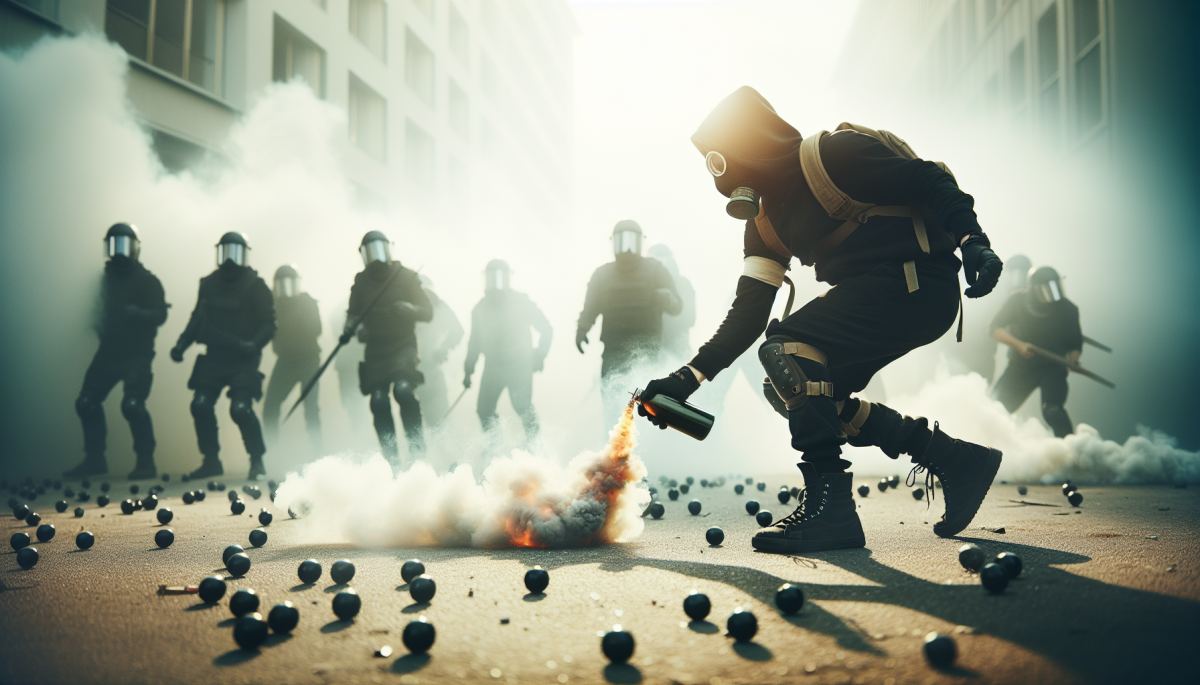
The firebomb landed at the wrong end of history, or perhaps exactly the right one, depending on your vantage point. Early Friday morning, San Francisco police arrested a 20-year-old man suspected of throwing a Molotov cocktail at the Russian Hill home of OpenAI CEO Sam Altman. Surveillance cameras captured the incident shortly before 7 a.m. ET. Hours later, someone matching the suspect's description was spotted making threats outside OpenAI's offices. No injuries were reported, but the symbolism of the act landed with considerable weight.
Sam Altman is not merely a tech executive. He has become, fairly or not, the most recognizable human face of artificial intelligence's rapid and disorienting expansion into everyday life. OpenAI's products, particularly ChatGPT, have reshaped how millions of people write, work, and think. That visibility makes Altman a lightning rod in a way that few corporate leaders have been in recent memory. When people feel threatened, confused, or displaced by a technology they cannot fully understand or control, they reach for the nearest symbol. On Friday morning in San Francisco, that symbol had a home address.

San Francisco has always been a place where technological optimism and social desperation share a zip code. The city that incubated the personal computer revolution, the social media era, and now the AI boom has also watched its housing costs spiral beyond reach for working residents, its streets hollow out during the pandemic, and its identity become synonymous with a kind of wealth that feels extractive rather than generative. The tension is not abstract. It lives in the neighborhoods.
Russian Hill, where Altman's home sits, is one of the city's most expensive and historically insulated enclaves. OpenAI's offices, also in San Francisco, represent the institutional center of a technology that has already triggered layoffs across writing, customer service, legal research, and creative industries. For a 20-year-old navigating that landscape, the geography of grievance is not hard to map. Whether the suspect's motivations were ideological, personal, or symptomatic of a mental health crisis remains to be established through the legal process. But the act itself did not emerge from a vacuum.
The United States has seen a pattern of politically and economically motivated violence directed at high-profile technology figures and institutions accelerate in recent years. The attempted assassination of a UnitedHealthcare CEO in late 2024 shocked the country partly because of how much public ambivalence followed the initial shock. A similar, quieter ambivalence has trailed this story. That ambivalence is itself a data point worth examining.
The most significant consequence of this incident may not be legal or even political. It is likely to be architectural, in the broadest sense of that word. Expect a quiet but meaningful hardening of the physical and digital perimeters around AI's most prominent figures and institutions. Security details will expand. Public appearances will be more tightly controlled. The already considerable distance between AI leadership and the general public will grow wider, and that distance has consequences for accountability.
When the people building transformative technology become less accessible, less visible, and more insulated, the feedback loops that might otherwise moderate their decisions weaken. Critics, journalists, and concerned citizens already struggle to engage meaningfully with the governance of AI systems that are reshaping labor markets and information ecosystems at scale. A security-driven retreat from public life by figures like Altman would further concentrate decision-making inside institutions that are already opaque.
There is also a chilling effect to consider on the other side. Legitimate protest, organized dissent, and public pressure campaigns against AI companies depend on a culture that distinguishes between speech and violence. Incidents like this one make that distinction harder to hold in the public imagination, and they give institutions legal and rhetorical cover to treat scrutiny as threat.
The 20-year-old now in custody will face serious charges. The house on Russian Hill sustained damage. And the broader system, the one that produced both the technology and the rage directed at it, continues operating without interruption, which may be the most unsettling detail of all.
Discussion (0)
Be the first to comment.
Leave a comment